Monday, November 7, 2011

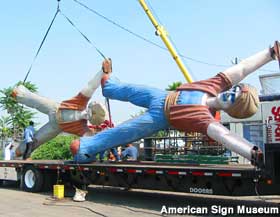
West Coast Bar-B-Q Heads to Beantown for a Makeover

In a cooperative effort with the Museum of Neon Art (MONA), the pole
sign came to the American Sign Museum, with the remainder going to MONA
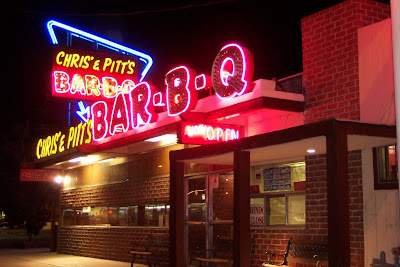
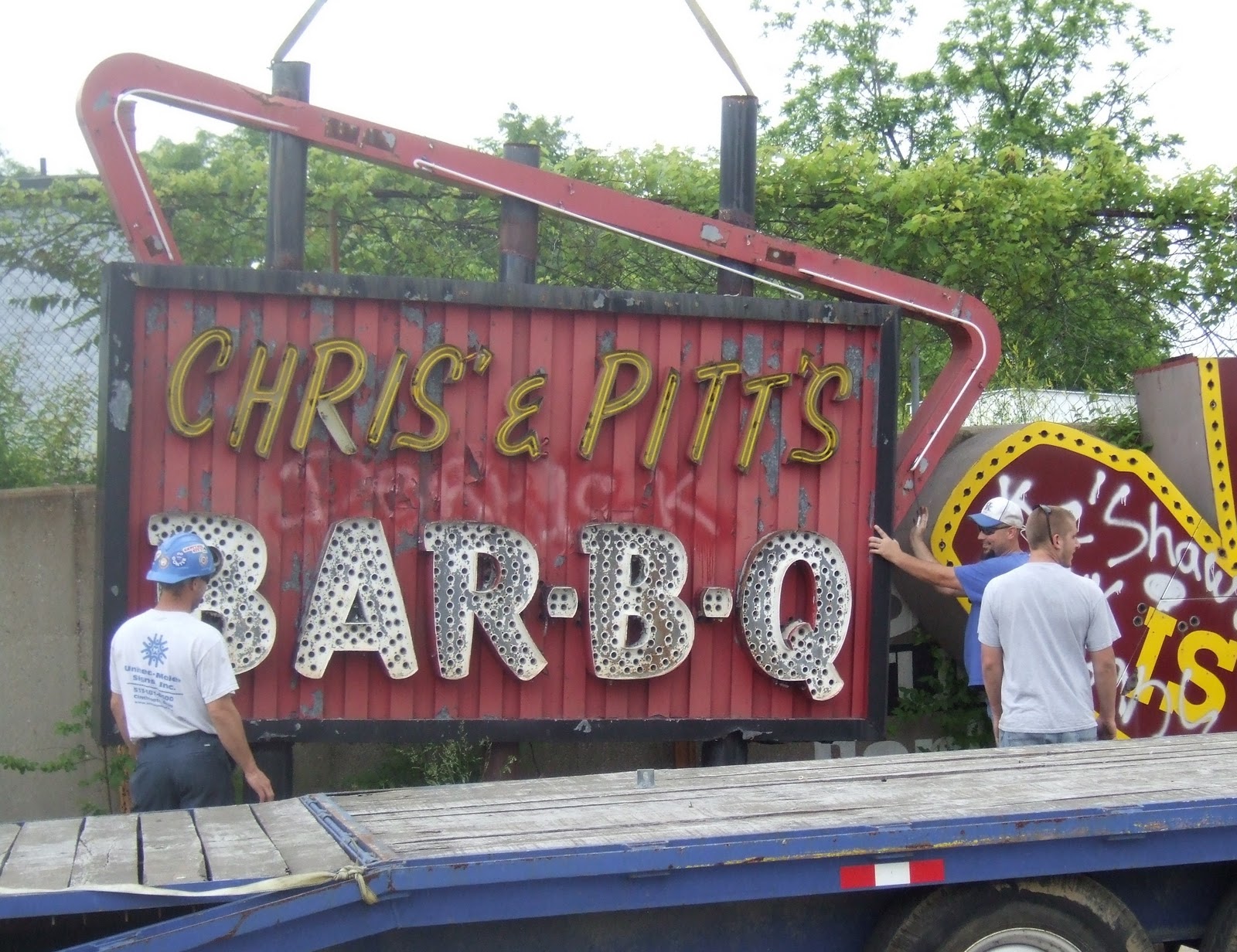
This grand sign once heralded Store #5, thought to have been located just blocks from the Peterson Car Museum in Los Angeles. When it came to us, already in disrepair, it suffered further indignities at the hands of passers-by while it waited in the Essex Studios parking lot for a home at our new site. We eventually were able to move it and other equally defaced signs to the new site, but the damage was done.

The United-Maier crew assesses several signs on their way
to safety at the American Sign Museum's new site
Imagine our delight when Andy Puopolo, owner of East Coast Sign Company, Inc. of Stoneham, Massachusetts, asked about restoring a sign for the museum. We suggested Chris' & Pitt's, and he agreed.

That was the easy part. Getting it to Andy was another matter entirely! The height of the sign measured 13' 4" on the trailer, making for anticipated tight squeezes under overpasses and sundry cables. Wishing to visit sign shops along the way added to the adventure, resulting in some long-distance backing up and just a few go-arounds!

Kahnie the Pig looks on as the Chris & Pitts sign heads out 
The weight of the sign made for additional fun in removing it from the trailer, but it's now, waiting patiently at its adopted home to be brought back to life again.

Unloading at East Coast Sign Company
I should aso mention that John Brandmeier, Sales Manager of Matthews Paint, had offered to provide the paint gratis for future museum restorations. Chris' & Pitt's will be the first such project.

The sign needs a total re-paint, in addition to neon repair of the vintage noviol gold glass in the open channel letters and the blue border tubes. Can't wait to see it back to its former self again!  Stay tuned...

In the meantime we have several other signs waiting to be adopted. If you're interested in restoring a sign - or paying to have a sign restored - give me a call (513-258-4020) or send me an email. I'm sure we can find a perfect match for you!

Saturday, November 5, 2011

The Devil, As They Say, Is in the Details


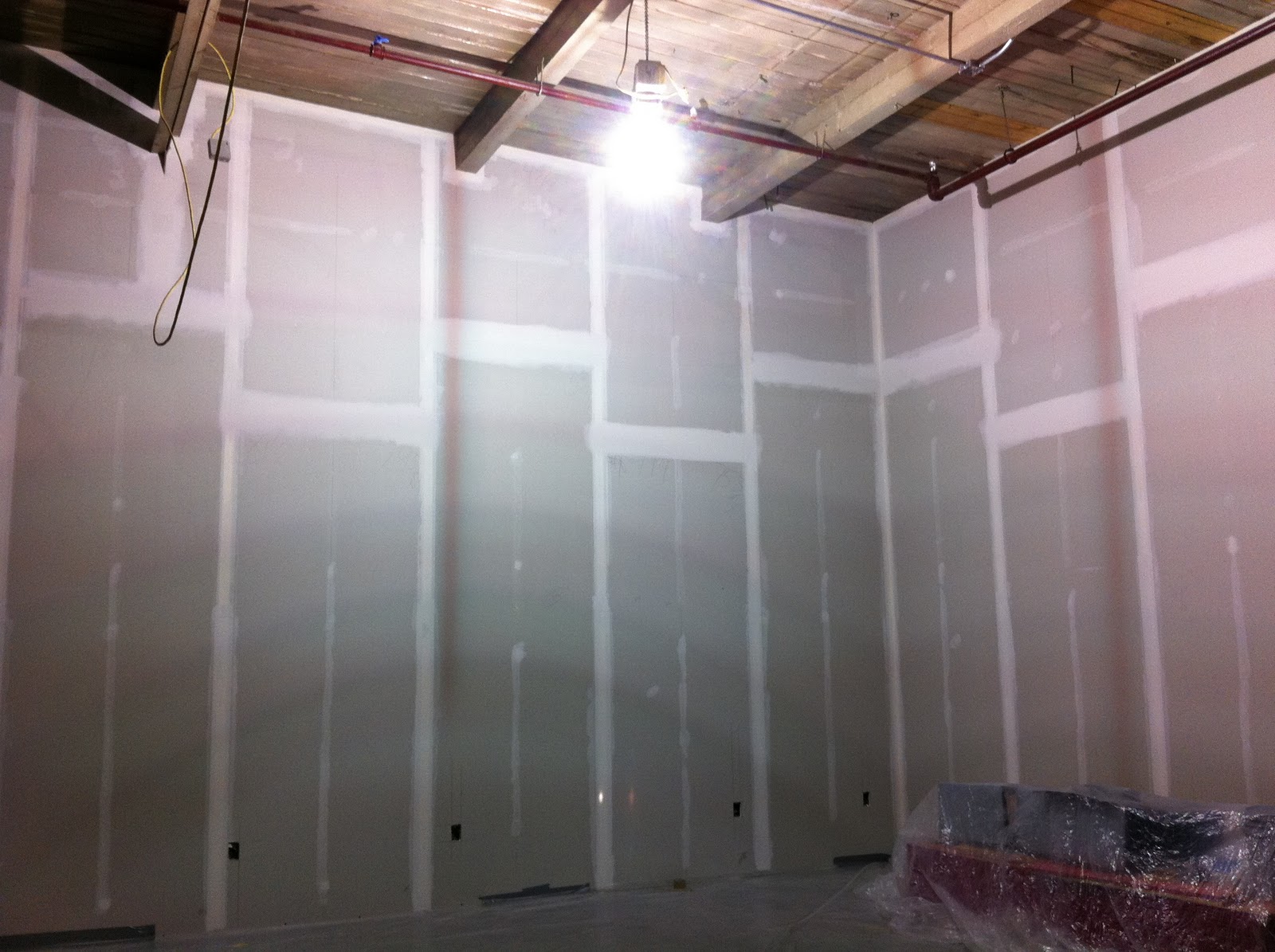
Tod talks with workers about painting the ceiling
It seemed simple enough. We had the money, we had the blueprints, we certainly had the motivation.

And so it began. Ceilings were knocked out, the floor was poured. Framing, painting, electrical, HVAC, all in their turn. And each needing more decisions than anyone should have to make in a day.  

And so it continued. Bathroom fixtures, IT needs, gift shop design. But oh, the joy in seeing it come together more each day!
Can you see it?
The building itself is on target for completion by the end of the year. And then the REAL fun begins! Fabricating displays, furnishing the lobby, developing programs for a great museum experience, moving EVERYTHING from EVERYWHERE and consolidating it all into THE NEW AMERICAN SIGN MUSEUM, complete with library/archives, event center, and, of course, signs, signs, signs! 
The Main Street storefronts are taking shape
Did I say we had the money? Well, yes, we DO have the money to rehab the building. Creating the complete package we can all be proud of and sustaining it is something else again. But we're on it, and confident 'investors' will come forward to sponsor areas of the museum, adopt a sign, participate in our purchase a paver / paint a panel program, or any of many other ways to be a part of the museum.

If YOU would like to join in, send me an email or give me a call at 513-258-4020 anytime. Together, we'll find the perfect project for you. The more, the merrier!
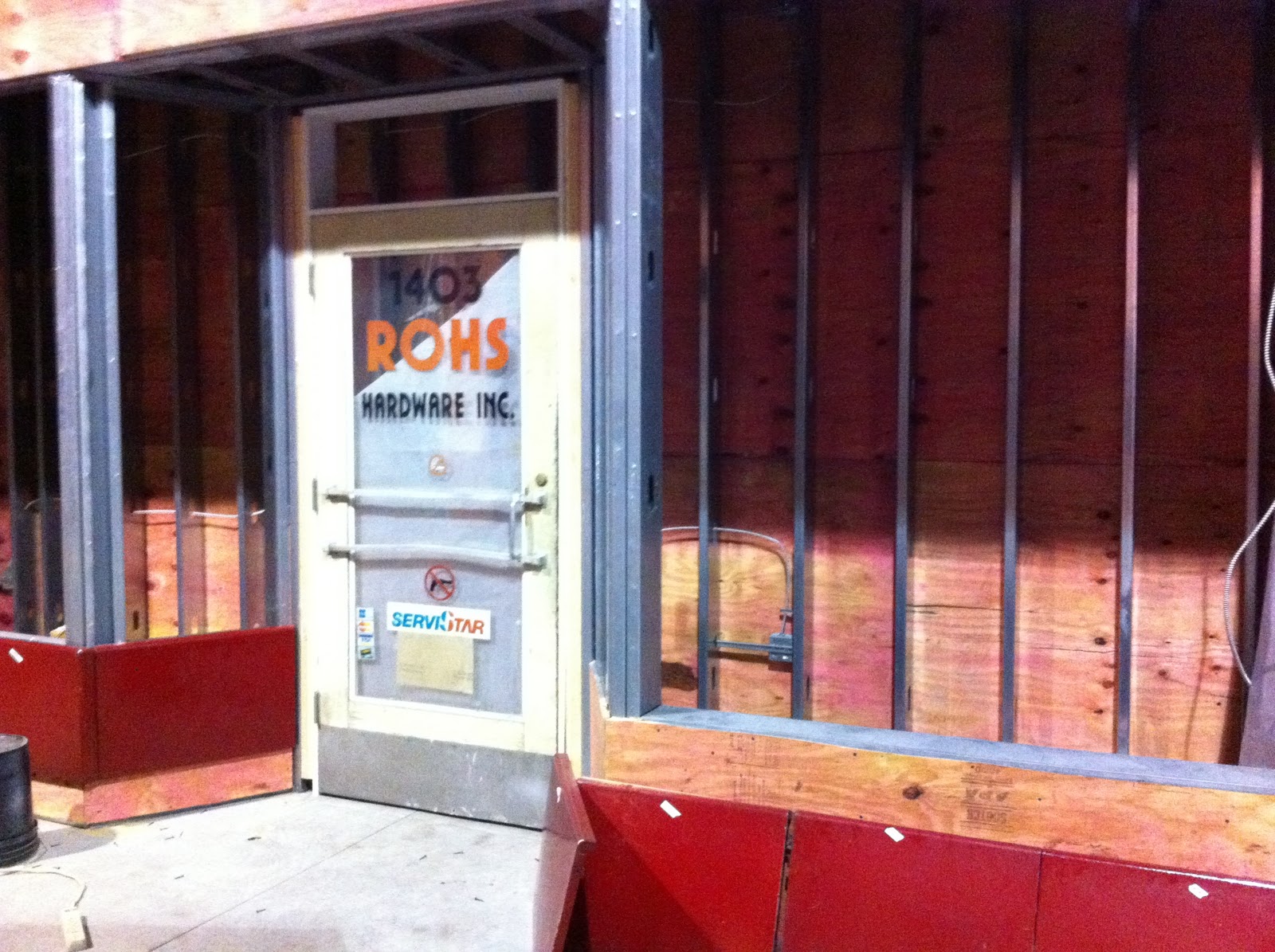
Our first storefront, brought panel by panel from the Over the Rhine
area of Cincinnati. Can you see the 'No Guns' sticker?
No detail too small for creating 'the Experience'!

See you at the Grand Opening!

Monday, October 24, 2011

It's Hammer Time!

If you look VERY carefully at this rendering of the new museum site and squint just right, you might spot a hammer-shaped sign in the mix. Can you see it?
The Gross Hardware sign, from Columbus, Indiana, was given to the museum several years ago. Sadly when the business closed, the neon was removed and the hammer primed out. There were no graphics left, which made the sign that rare candidate for repainting.

Dan Kasper, now retired president of Harmon Sign/Planet Neon, and former museum board member, agreed to restore the sign, so it traveled directly from Columbus, Indiana to Toledo, Ohio, where it was lovingly restored to its original glory.

Susan Kuntz, veteran Harmon employee since 1976,
carefully brings the Gross Hardware sign back to life.
We recently traveled to Toledo to retreive the sign.
Scott Markley helps prepare our trailer
to transport is valuable cargo.
And now, not only are the MacDonald's and Howard Johnson signs anchored and the store fronts taking shape, but the hammer sign is in the wings (read: parking lot) waiting to take its place on Main Street.

Thanks to everyone who helped bring this great sign back to life on its way to the museum for all to enjoy at our new site when we open this spring.


Friday, September 30, 2011

What Beats Saving a Sign? Saving the Storefront It Occupied Too!

Rohs True Value Hardware opened it's doors in 1933 under the management of its proprietor, Albert G. Rohs, on Vine Street in the Over the Rhine neighborhood of Cincinnati.
Rohs Hardware in 2008
Photo courtesy of www.buycincy.com

Al Rohs with just
some of his wares
Photo courtesy of
www.buycincy.com
I was first drawn to the neon-illuminated, porcelain enamel letters that fronted the building. So, last spring when I saw a 'Going Out of Business' sign in the window, I approached the current owner — Albert R. Rohs, Albert G's son — about the donating the letters to the American Sign Museum. 


Then I noticed the storefront had been retrofitted with porcelain enamel panels, and I thought to myself, “What a great addition the façade would make to our ‘Signs on Main Street’ exhibit area.

When Rohs closed, a local developer named Rick Kimbler of Northpointe Realty, Cincinnati acquired the building. I asked him about plans for the porcelain panels, and he said they would probably remove and discard them. I told him of my plans, and he thought it an appropriate re-use. He would talk with his general contractor, Bill Baum of Cincinnati-based Urban Sites, about the idea.

Baum followed up, giving us a basic go-ahead and suggesting we meet to discuss coordinating the removal of the porcelain letters and panels. But when I met Baum and architect Mark Gunther of Wichman Gunther Architects later that week, Gunther said, “There’s a good deal of Federal money financing the redevelopment,” said Gunther, “and we have to meet historic preservation criteria. Odds are removing the panels will jeopardize the federal money.” My heart sank. “Let me research it,” Gunther said. We would just have to wait for the verdict.

Then, the local daily—Cincinnati Enquirer—featured the museum’s new home in its Labor Day weekend Sunday edition. Mention of the possible reuse of the Rohs storefront prompted Albert’s daughter, Karen Rohs Laib, to e-mail the reporter about how great it would be if the Rohs storefront went to the museum. I sent copies off to all the parties involved.

A few weeks later, Bill Baum called. “Hey, they’re all yours,” he said. Sean Druley, who is building the displays and exhibits at our new home, friend Toby Costello, and I set out on a Tuesday afternoon, grateful that the rain of the day before and earlier that day had stopped. By 5:00 that afternoon, we had all the panels and letters down and strapped onto the trailer, far ahead of our schedule. Wednesday—our original completion day—it rained from dawn to dusk. It was just one of those meant-to-be projects.

Toby Costello (left) and Sean Druley (right) removing the letters and panels
that will be reassembled along Signs on Main Street at the American Sign Museum 

Friday, September 16, 2011

What do Two Genies, a Pig, and a Bowling Pin Have in Common?

Museum founder Tod Swormstedt's article from Signs of the Times Magazine, October, 2012

We actually have two genies, one at each entrance
of the current and new sites. We plan to install the
current site genie atop the front building at the new
site, where he will beckon travelers on I-75.
The outdoor area of the Museum’s new home is starting to look like it's going to feature the three-dimensional fiberglass “sculptures” that were so popular in the mid 1950s through the late 1960s.  Our 20-ft. tall genie, which has become somewhat of a mascot, now stands over the walkway atop two 12-ft. poles at the museum’s entrance.  Two other additions—a 16-ft. long trailer-mounted pink pig and the most recent acquisition, a 16-ft. tall 3D bowling pin—now sit outside in the parking lot awaiting installation. 

“Kahnie” as the pig was appropriately (and affectionately) named, was donated by Kahn’s, a Cincinnati meatpacking company now under the umbrella of Sara Lee foods.  Kahnie had long been a favorite participant in Cincinnati events, and is most remembered for her appearance in the annual Cincinnati Reds Opening Day parade.  In keeping with current trends, Kahnie was replaced by an inflatable counterpart, whose flexibility promoted more practical transportation and set-up.  Word has it that Kahnie is already adapting to her new home.
Kahnie and genie at night, taken before Pinhead's arrival.
Pinhead is happy to be coming to the
America Sign Museum.
She is being joined by “Pinhead,” a 16-ft. tall fiberglass bowling pin that originally identified Greenbrook Lanes in Greenbrook, NJ.  The acquisition began when Phil Smith, Jr. and his father, Phil, Sr., of Ace Sign Company in Perth Amboy, walked up to me at the USSC Sign World show in Atlantic City last year.  They told me that they had this huge bowling pin that had been leaning up against their shop for at least 15 years and wanted to know if the museum was interested in it.  I responded with an enthusiastic yes and told them I’d be up that way the following May and could they hold onto until then. 
Phil, Jr. later told me the whole story.  “The bowling pin had been a local icon since the late 1950s,” he explained, “but the owner sold the business and opened a new bowling alley in nearby Manville and asked us to move the pin.  He told us we didn’t need to install it: ‘Just move it to my new place and tie it down with ropes and I’ll install it myself later.’”

“It was too long afterwards,” continued Smith, “that we got a call from the guy saying the police had called him, telling him to get the bowling pin out of the middle of the street ASAP or face the consequences.  He had obviously not mounted the big guy properly.  We went over and brought it back to the shop to await further instruction and never head from the guy again.  That was at least 15 years ago.”

Smith went on to tell me that the smiling face was added sometime during its tenure at Greenbrook, and that a tin-sheathed plywood top hat was added to top him off.  The hat had deteriorated over the years. 

The bowling pin’s interesting history was not unlike the shop that rescued it.  Ace Sign Company was co-founded in 1928 by Phil, Jr.’s grandfather, David, and  his partner, “Ace” Friedman, a former boxer.  Ace was the salesman; David was the signpainter.  The shop got a big boost when it began doing work for Leon Hess’s oil company, Hess Oil, which was founded in Perth Amboy.  The shop grew to employ eight signpainters at its height.

ACE Sign Company, the early days.
In the early 1970s, Ace Sign expanded to begin offering backlit plastic signs to its local customer base.  It continued to maintain its separate neon plant as it had since the beginning.  Under Phil, Sr., the shop became a beta site for Gerber Scientific Products first vinyl cutter in the early 1980s; computerization was fully integrated by the late 1980s.  Although Ace Signs days of employing eight signpainters are gone, it still paints some of Hess Oil’s local storage tanks.  The company is currently operated by Phil, Jr. and his brother, David.  Father Phil, Sr. is semi-retired. 
Phil Jr. shares stories of other fiberglass giants
Following a tour of the shop, Phil Sr. poses with Tod and Pinhead.

Tuesday, August 30, 2011

Farewell to a Legend

Quintessential Keith
courtesy of Roberta deBoer
Keith Knecht died early this morning. Quietly. Peacefully. 

He knew it was coming. In fact, he had a little something to say in the matter. He chose to stop the procedure that was keeping him alive, because the quality of life it offered just didn't measure up to his standards. That was Keith.

And knowing his own death was imminent, he did what anyone would have done... he threw a party!  Scores of his friends from across the country came to Toledo to swap stories and memories and to catch up with old friends not seen - in some cases - for decades. That was Keith.

Those who knew him thank him for friendship, his talent, and his spirit. Perhaps you knew of him. He was that kind of guy. I hope you'll share your Keith stories here.

Below is his obituary, which pretty much sums it up. Rest in peace, old friend.

Keith signing the fantasy show card he had
previously donated to the museum. His brother plans
to donate several more, for which we are very grateful.
Photo courtesy of Bob Behounek
“There’s a race of men that don’t fit in,
A race that can’t stay still…”
     These words by Robert W. Service begin one of the favorite poems of Keith Knecht, of Toledo, who died August 30, 2011.
     The last stanza of the poem begins, “He has failed, he has failed…,” but no such charge could be made against Keith, whose life was successful precisely because he couldn’t and wouldn’t fit in.
     Keith was a pin striper and itinerant sign painter, a man with the soul and gifts of an artist. His 71 years prove that passion and integrity are sufficient to govern a lifetime. Keith made a living doing what he loved, answering to no one but himself, and this alone made him rich.
     Renowned for his work, he won myriad awards and was frequently interviewed by trade magazines, even appearing in cover stories. Years of honors crystallized in 2009, when he became the eighth person in North
America chosen by his peers for a Lifetime Achievement Award.
     Receiving this honor in Detroit’s Cobo Hall from the Letterheads (a national brotherhood of sign painters), Keith said: “I got this award for having too much fun.”
     Untethered by marriage or family obligations, his art and livelihood allowed him to live much of his life on the road, brush in hand.
     His work was found in Canada, California, Colorado, Florida (and all along the highways leading there), as well as Las Vegas and the East Coast.
     Keith stopped painting when he began to lose his vision five years ago, shortly after computers dominated sign painting. Both developments broke Keith’s heart. Of the sorry state of modern sign painting, he said:
     “There’s no romance in it anymore. When I had a brush in my hand, man, I was at peace. The brush wasn’t an extension of my hand, it was my hand. Try getting that out of a computer or some vinyl sticker.”
     Keith’s death, like his life, occurred on his terms. Health declining, in late August he ended thrice-weekly dialysis. Two days after his last treatment, he had the pleasure of hosting a party, gathering friends from across the country.
     This renaissance man – lover of political debate, history, jazz, doo-wop, stylish hats, old movies, Packards, a game of pool well-played, and all things Art Deco – made his mark and will be missed.
     He is survived by his hero and brother, Bruce Knecht, also of Toledo.
     As Keith wished, there was a party August 26 in place of funeral services, and he thanks his friends for coming. If you’d like to memorialize Keith, please consider a donation to the American Sign Museum, in Cincinnati, or Hospice of Northwest Ohio.          

Wednesday, August 17, 2011

Yahoo! It's actually happening!

Why is Kahnie the pig so happy?

Thanks to a very generous anonymous gift to the museum’s Capital Fund, we now anticipate completing renovations of our permanent home in January 2012. 
The 19,300 sq. ft. facility is about 450% larger than the museum’s current home at Essex Studios in the Walnut Hills area of Cincinnati.  The historic building will allow us to consolidate all operations under one roof, bringing together our extensive collection of historically significant acquisitions. The collection includes a photo archive filled with nearly 1200 vintage black-and-white prints and transparencies, as well as a substantial library of more than 800 sign-related books and catalogs.
Signs are lining up in anticipation of moving into their forever home
Workers kick up the dust as
they begin the demo phase
The main area of the museum -- designated “Signs on Main Street”-- focuses on a street scene characterized by life-size storefronts stretching along and facing in towards a “town square.”  The three-dimensional, period storefronts serve as a backdrop for a range of historic signs, and the windows of the storefronts showcase smaller signs and sign-related objects.  

The 28-ft. high ceilings of the town square area of “Signs on Main Street” serve to display some of the museum’s larger signs.  Among these are some great American icons including a 1963 Speedee McDonald’s sign and a 1958 Howard Johnson’s sign.  Another especially exciting addition will be a working neon shop where museum visitors can watch neon production first-hand. 

We are also planning an events area that will enable the us to transform the museum into an entertainment venue with the latitude to play host to meetings, seminars, and receptions.  A full-scale (16 x 50-ft.) Mail Pouch barn wall sign, rescued from Lanesville, IN, will serve as the backdrop for such activities.
We are very excited about moving forward on this MAJOR step for the museum and can't wait to share the grand opening of your American Sign Museum. We hope you're excited too! 

But while the gift secures the completion of the general construction, we must raise an additional $200,000 for:
  • designing, fabricating, and installing the new exhibits
  • restoring many signs that have been waiting in the wings for their big debut
  • moving EVERYTHING from our current location
  • adding the needed technology and furnishings to complete the museum
If you have not supported the museum in the past, there has never been a better time to do so.  There are many ways to join in the excitement and support the museum:
  • make your mark (literally) with your personal message that will be a part of the museum forever by purchasing a paver or painting a panel that will line the entrance floor and lobby wall, respectively. 
  • restore a sign through our Adopt a Sign program: Sponsor the restoration of a specific sign or even restore a sign in your own shop.   
  • become a member.
To all of you who have supported the museum to date, our sincere thanks.  You can be proud for the part you’ve played in making it all come together.  To those of you who are waiting for the chance, there’s still time.  Become a member online or contact me at 513-258-4020 or tod@signmuseum.org.